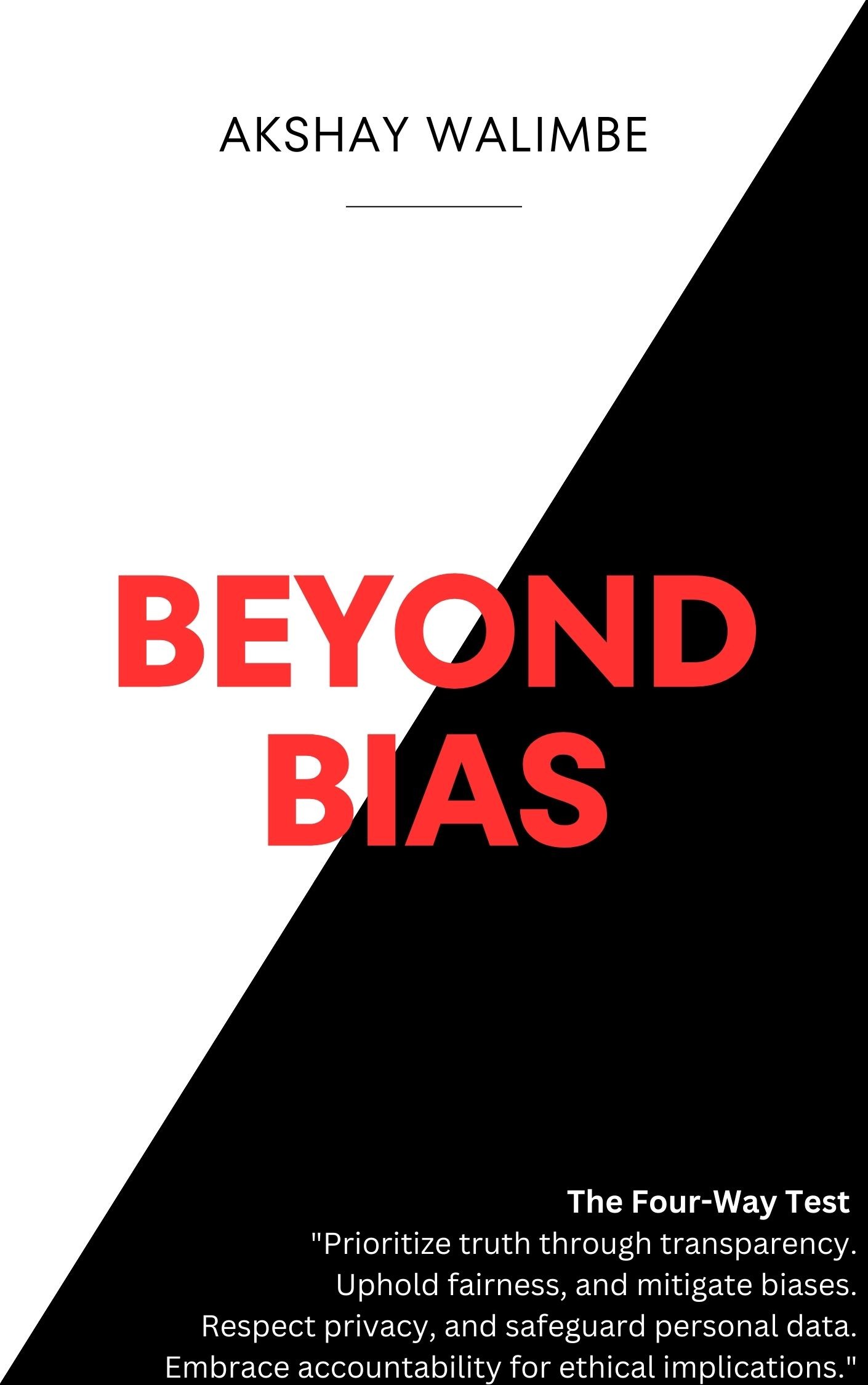

Akshay Walimbe

Beyond Bias

Beyond Bias: The Four-Way Test for Ethical AI

A practical guide for anyone using AI or planning to. No jargon. No PhD required. Just the truth about how AI makes decisions about your life, and what you can do about it.

Why This Book?

You already use AI. You just might not know it.

Every time you tap your phone to make a UPI payment, an AI is deciding whether that transaction is legit or fraud. When you type “something spicy for a rainy evening” on Swiggy, a language model trained on fifty million food items is interpreting your very human, very vague request. When a farmer in Madhya Pradesh asks a crop question through a WhatsApp voice note in Hinglish, an AI built specifically for Indian agriculture is on the other end.

AI is not coming. It is here. It is in your bank, your hospital, your child’s college admission process, your job application, and your daily commute.

But here is what nobody is telling you clearly enough: these systems are making decisions about your life, and most of them cannot explain why. They reflect biases nobody programmed on purpose. They use your data in ways no consent form ever covered. And the people building them? Fewer than one in three companies have written down the rules for how their AI should behave.

Beyond Bias is the book that tells you the truth  in plain language, with real stories, and with a framework you can actually use.

Why This Book?

Not the marketing version. Not the doomsday version. The real version. How AI learns, what it can do, what it absolutely cannot do, and why it sometimes makes things up with complete confidence. You will walk away knowing enough to ask the right questions in any boardroom, any classroom, or any dinner conversation.

AI does not have opinions. But it has training data. And that training data carries every bias of the world that produced it  gender, caste, region, language, income. When Amazon built an AI to screen resumes, it learned that men got hired more, so it started penalising women. When facial recognition systems were tested across skin tones, they worked nearly perfectly for light-skinned men and failed almost half the time for dark-skinned women. These are not glitches. These are patterns, learned from data that reflects an unequal world.

In India, the stakes are uniquely high. PIN codes that stand in for caste. Surnames that predict community. Fingerprint scanners that work on office workers but fail on labourers whose hands have been worn smooth by cement and chemicals. Five hundred million rural Indians who are invisible in the data that trains these systems. This book shows you exactly how this works  and what to do about it.

Most AI systems today are black boxes. They make decisions  about your loan, your 0diagnosis, your job application  and nobody can explain the reasoning. Not the company that built it. Not the person who deployed it. Sometimes not even the engineers who trained it. This book breaks down the transparency problem and shows you what a right to explanation actually looks like.

Your photos, your messages, your browsing history, your purchases  all of it is training AI models you have never heard of. The consent forms you clicked “agree” on were written for a world that no longer exists. India’s Digital Personal Data Protection Act is a start. But the gap between what the law covers and what AI actually does with your data is enormous. This book maps that gap honestly.

There is a shift happening right now that most people have not absorbed. AI is moving from a tool that answers questions to an agent that takes action. Systems that book your travel, send emails on your behalf, approve loans, reject candidates  without a human reviewing the decision. The technology that handles thirty-minute tasks today will handle day-long tasks within a couple of years. The question of who is responsible when the machine decides is the most urgent ethical question of our time. This book takes it head on.

This is not an academic textbook. It is a practical guide built around four questions  adapted from a framework that saved a bankrupt company in 1932 and went on to be adopted by millions of people worldwide:

Is it the Truth?

Is it Fair to all concerned?

Does it respect Privacy?

Is anyone Accountable?

Four questions. Every AI decision. Whether you are a student evaluating an AI tool, a professional using AI at work, a founder building with AI, or a citizen affected by AI  these four questions will change how you think about every interaction with a machine that makes decisions.

Who Is This Book For?

If you use AI in your work whether you are a product manager, a startup founder, a marketing professional, a teacher, or a doctor this book will help you ask the right questions before you trust a system that affects people.

If you are a student preparing for a world where AI is the infrastructure, not the novelty this book gives you the vocabulary, the frameworks, and the case studies you need to enter any industry with your eyes open.

If you are a working professional wondering what AI means for your career, your industry, and your daily decisions this book cuts through the noise and gives you an honest picture. No hype. No panic. Just clarity.

If you are a citizen whose loan applications, medical scans, job prospects, or government benefits are increasingly decided by algorithms this book tells you what is happening, why it matters, and what your rights are.

You do not need a technical background. This book was written for people who want to understand AI the way you understand a car well enough to drive it safely, spot when something is wrong, and know when to ask a mechanic.

What Makes This Book Different?

It is written from India, for the world.

Most AI ethics books are written in the West, for the West. This one starts from the Indian reality eight hundred million internet users, five hundred million still offline, twenty-two official languages, a caste system that maps onto AI datasets with terrifying precision, and a regulatory landscape that is being written as we speak. The problems are universal. The lens is ours.

It tells real stories.

Every chapter is built around real case studies the Amazon hiring tool that penalised women, the facial recognition system that failed on dark-skinned faces, the eleven-year-old girl who died of starvation because a fingerprint scanner could not read her mother's hands. These are not hypothetical scenarios. They have already happened.

It gives you tools, not just theory.

Every chapter ends with practical checklists, audit frameworks, and questions you can start using tomorrow whether you are evaluating a vendor, designing a product, writing policy, or just trying to make sense of the AI tools landing on your desk every week.

It is honest.

This book will not tell you AI is evil. It will not tell you AI will save the world. It will tell you the truth: AI is powerful, it is flawed, it is already shaping your life, and the decisions we make about it in the next few years will define the next few decades.

About the Author

Akshay A. Walimbe is an AI practitioner who builds the systems this book is about. He is not writing from a university lecture hall or a think tank conference room. He is writing from the engineering floor  where the decisions about data, models, and deployment are made every day, and where the gap between ethics frameworks and nine-AM-on-a-Tuesday reality is widest.

His maternal grandfather  his nana  was a school teacher in a small town in Maharashtra, known as Pujari Guruji, who taught his six children four values: truth, fairness, humility, and checking your own biases before you judge anyone else’s. This book is the product of those values meeting the reality of building technology that makes decisions about people.


The Book at a Glance

  • The Machine That Learns – What AI actually is explained through a sarkari office warehouse, not a computer science textbook

  • Where Bias Lives – How AI inherits and amplifies every bias in the data gender, caste, region, language and why removing one variable does not fix it

  • The Black Box Problem – Why most AI cannot explain its own decisions, and what your right to an explanation looks like

  • Fair By Design – What “fairness” actually means when you try to build it into code and why it is harder than anyone admits

  • Your Data, Their Model – How your personal data trains AI models, why consent is broken, and what India’s privacy law does and does not cover

  • When AI Acts – The rise of AI agents that act without permission and the accountability crisis this creates

  • The Regulatory Landscape – Where the rules stand today in India, the EU, the US, and China and where they are heading

  • The Hidden Costs – The energy, the labour, the power concentration the ethical price tag nobody puts on the balance sheet

  • The Four-Way Test in Practice – Templates, checklists, and role-specific guides you can use starting Monday

  • What Comes Next – Where all of this is heading and what you can do about it now

Stay in the Loop

Be the first to know when Beyond Bias is ready.

This book is being written to be a snapshot and a compass  a record of where we stand in 2026 and a guide for what comes next. If you want to be the first to know when it is available  for pre-order, signed copies, or early access  leave your details below.

We will notify you when the book is available for pre-order or signed copies. No spam. Just the update you are waiting for.

Privacy note: Your information will only be used to notify you about this book. We practise what we preach your data stays private.

Four questions. Every decision. The ethics of AI, made simple enough to remember and strong enough to live by.

Scroll to Top